In this age of Facebook, we can get daily reminders of the birthdays of our social contacts. Also, if you sync your calendars you can look ahead and see the upcoming birthdays as well. So what is the big deal?
The big deal is that you can make a small difference in someone's life by just remembering their birthday (even if you don't have to remember). I can say from personal experience that I like it, even when a distant friend or contact remembers that it is my birthday. And, it is going to make you feel good too by remembering someone else's birthday and saying something nice to them.
So say Happy Happy Birthday whenever you get a chance. It is so easy, and makes such a big difference.
Happy Happy Birthday.

Thoughts from a family law and divorce lawyer.
Monday, January 27, 2014

Wednesday, January 15, 2014
Children, Divorce and Taxes (Part 1)

We have answers!
For all of your questions, we created a three part series regarding common questions about children, divorce and taxes. This post addresses questions about how to decide who can claim the children in the absence of a court order.
- Who is a qualifying individual for the dependent exemption?
In the case of a child, a person under the age of 19 or under 24 if a student as of the close of the tax year, for whom the parent has provided over half of the child’s support.
- Do the parents need to prove that they have provided more than 50 percent of the child’s support during the year?
No, generally parents don’t have to prove they have provided the support. But this is a requirement if a person other than the parent is seeking to claim the child tax exemption.
- Are there special rules for divorced parents?
Yes, the IRS sets out special rules for which parent can claim the child. This is generally the custodial parent: the parent with whom the child has spent more than 50 percent of the year.
- Who gets to claim the child tax exemption if there is no court order?
You will have to use the IRS’s rules for determining who can claim the child.
- How does the IRS determine who can claim the child?
The IRS looks at who is the custodial parent, who is the parent the child lives with for the greater part of the year, and generally allows that parent to claim the child.
- Who can claim the child if both parents had the child an equal amount of time?
In this case, the parent with the higher adjusted gross income may claim the child tax exemption.
For the extended article, check out our January newsletter. If you have more concerns regarding children, divorce and taxes, feel free to email me at contact@evantaylorlawoffice.com and we will provide answers to your questions!
Tuesday, January 7, 2014
New Year, New Decisions
Do you know that starting a new relationship while your divorce is still in process can cause consequences to your case? Do you know the nine magic word answer to use in court just in case you might think of more information at another time? Also, do you know that a divorce case in Cleveland County typically takes about 200 days?
Answers to these questions and others are available on our website at one location for your convenience. The divorce process is a long and complicated one, but we want to provide you with the right information to keep you informed and in control.
Our resources page is constantly being updated with articles that can assist you during your family law case. If you have a question that is not already answered on our website, please feel free to email us at contact@evantaylorlawoffice.com.
Wednesday, November 13, 2013
OBA Annual Meeting
One of my favorite times to be a lawyer is when I get a chance to get together and learn about the developments in the law with other Oklahoma lawyers. The people that are here for the continuing legal education (CLE) classes are the laywers that are developing the future of the practice of law.
This morning I am sitting in the second session of the Technology Track CLE, and listening to Jim Calloway talk about law practice marketing.
Thursday, November 7, 2013
Income Calculation Word Problems - Child Support
Hey, I wasn't very excited about math when I was in school. What a loss, because there is so much that math can describe. Of course, in my business the math I use is mostly arithmetic - when I am calculating income for child support.
Here are two word problems.
Johnny's Problem
Johnny works at the race track as a cashier. He makes $ 14 per hour, and has worked 72, 80, and 74 hours during the last three pay periods. He is paid biweekly and doesn't have any benefits. He also served in the military, and has a military disability rating, so he receives $ 340.00 per month in Veterans Administration Benefits. What is his average gross monthly income?
Katie's Problem
Katie is a stay-at-home mom but she has a business on the side. She makes bows for cheerleaders and does some tailoring for clients across the Oklahoma City Metro with the assistance of two part-time employees. She had been doing this for two and half years, and for the past year she grossed $ 45,800 and the year before $ 38,700. Her expenses have been the same for each year, at $ 12,000 in wages and employee related expenses, and $ 2,500 in materials, telephone and home office supplies. She also wrote off $ 600.00 in depreciation for each year on her taxes. She is married, and her husband, a police officer, makes $ 36,000 a year. What is her average gross monthly income?
Johnny's Problem
Johnny works at the race track as a cashier. He makes $ 14 per hour, and has worked 72, 80, and 74 hours during the last three pay periods. He is paid biweekly and doesn't have any benefits. He also served in the military, and has a military disability rating, so he receives $ 340.00 per month in Veterans Administration Benefits. What is his average gross monthly income?
Katie's Problem
Katie is a stay-at-home mom but she has a business on the side. She makes bows for cheerleaders and does some tailoring for clients across the Oklahoma City Metro with the assistance of two part-time employees. She had been doing this for two and half years, and for the past year she grossed $ 45,800 and the year before $ 38,700. Her expenses have been the same for each year, at $ 12,000 in wages and employee related expenses, and $ 2,500 in materials, telephone and home office supplies. She also wrote off $ 600.00 in depreciation for each year on her taxes. She is married, and her husband, a police officer, makes $ 36,000 a year. What is her average gross monthly income?
Tuesday, November 5, 2013
November/December Uncontested Docket

Judge Schumacher 1:3opm Courtroom 4D
| Date |
|---|
| November 12th, 2013 |
| November 19th, 2013 |
| December 3rd, 2013 |
| December 10th, 2013 |
| December 17th, 2013 |
| December 31st, 2013 |
Judge Walkley 1:30PM Courtroom 4A
| Date |
|---|
| November 14th, 2013 |
| November 21st, 2013 |
| December 5th, 2013 |
| December 12th, 2013 |
| December 19th, 2013 |
Monday, November 4, 2013
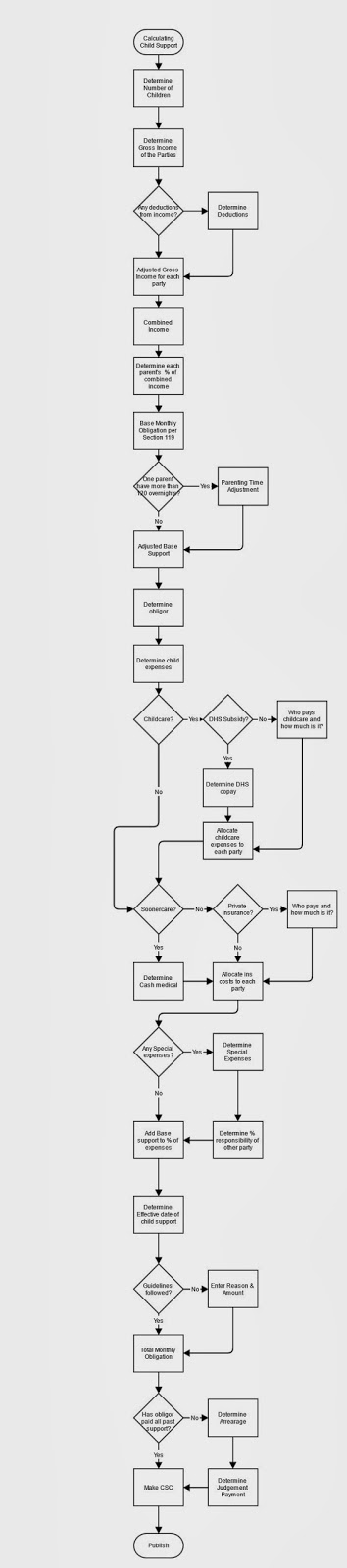
The Flow of Child Support : The Back End
 What does a child support computation look like from the back end? A lot like the array of sticky notes on the table in the picture to the right.
In Oklahoma, we have child support guidelines that tell us how to do the math to figure child support. These guidelines are just legal rules on what numbers we put in and how we put them together to figure child support.
For a taste of the guidelines you can review Section 118, 118a-i, and 119. Of course, the guidelines are just rules for what math to use, what really matters is the numbers that we put into them. These input numbers are what we lawyers spend most of the time fighting about.
We will be looking in later posts about how to calculate income and expenses related to child support, but I thought we could start with the computation itself. You can see the mechanics more clearly in the flow chart below, just click on it to enlarge.
 | |
| Child Support: | A Flow Chart |
Subscribe to:
Posts (Atom)